





Page Navigation


Select a different country or region to view content tailored to your location.


<p>Alison Heyerdahl is the Head of Content at FxScouts, a Chartered Market Technician (CMT), and an experienced trader, as well as a financial writer with extensive expertise in Forex trading, broker analysis, and market research. She has reviewed 100+ brokers, publishes weekly YouTube trading videos, and co-hosts the “Let’s Talk Forex” podcast.</p>


The Australian Dollar, sometimes called the 'Aussie', occupies a unique position in the world of currency trading. Many of the large Asian economies rely on state management of their currencies, and this makes trading them much harder.
For example, China and Japan are huge economies, but both nations exercise a lot of control in the Forex market. Australia does not seek to control the Forex market, whereas the Reserve Bank of Australia (RBA) takes a more western approach to the value of the Aussie.
This approach makes the Aussie a good way for traders to take a position in Asian growth, without all the uncertainty that comes with trading in the Chinese Yuan, or Japanese Yen.
The state of the Australian economy, as well as the global economy, are the most critical factors that drive the Aussie's exchange value. Regarding the specific relationship between the Aussie and the US Dollar, the elements in play can be nuanced. Abbreviated as AUD/USD, the Aussie/US Dollar cross is one of the most liquid currency pairs for the Aussie. Many traders also use it as a proxy for the relationship that the USD has with commodities and the outlook for both global and Asian growth.
Over the last decade, some new currents in the AUD/USD have emerged, though these may be a passing influence on the pair. No one factor will determine how any currency will trade, but there are a few essential market dynamics to keep an eye on. Most of them will relate to either interest rate expectations or the commodity market, both of which are hugely important for the Australian economy. There may also be an emerging trend towards higher interest rates in the USA, which could invert the historical relationship between the two currencies.
Australia has generally had a much higher interest rate than most of the western economies, especially after the European common currency was introduced. These higher interest rates have made the Aussie a favourite for 'carry traders', or people who want to gain from the difference between a lower-yielding currency like the USD or Japanese Yen, and the higher-yielding Aussie.
From a practical trading perspective in the AUD/USD, this makes the outlook for interest rates in the USA and Australia very important. At the moment the USA and Australia have the same overnight discount rate of 1.5%, set by the Federal Reserve and the RBA, respectively but this isn't the historical norm, and should these rates diverge again, it could have a severe effect on the value of the AUD/USD.
For example, if the US FED can raise rates, as it has told the markets it intends to do, this could drive capital flows from the Aussie to the USD. Conversely, if the US Fed is unable to raise rates because of the massive debt burden and deficit that the US is facing, and the commodity markets heat up because of USD weakness, the opposite could happen. A lot of what will unfold going forward could be a result of macro factors that are beyond the ability of the RBA to control, and aside from the Australian housing market, the Aussie's value will likely be driven by Asian growth and commodity prices.
As mentioned above, the AUD/USD is commonly used as a proxy trade for the commodity market. Because Australia is a massive producer of iron ore, coal, gold and industrial metals, the nation's GDP is primarily determined by how well the commodity complex is doing. When it comes to the AUD/USD, it is important to realise that many traders use commodities as an 'anti-USD' trade, and many times when the USD experiences weakness against other major currencies, commodities are bid higher as a result. This effect is doubly good for Aussie bulls, as rising commodities usually mean a stronger Australian economy, which translates into a fundamental reason for strength in the Aussie.
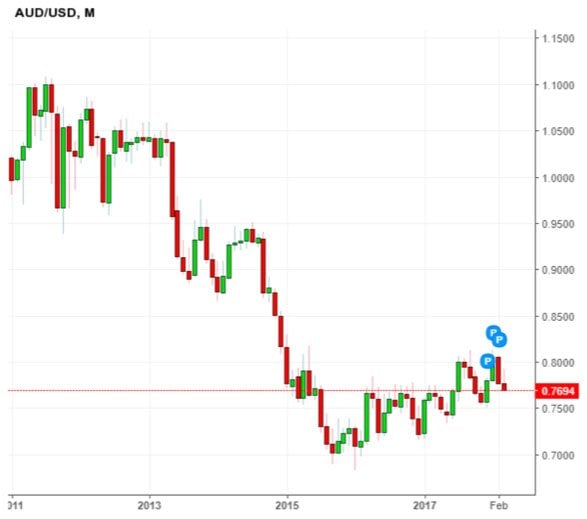
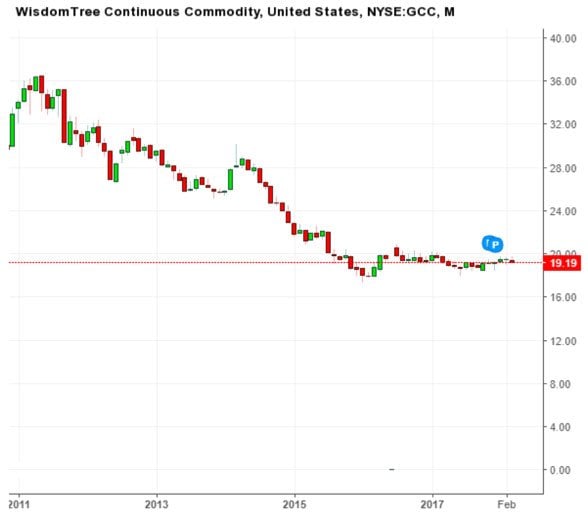
A booming economy usually means higher rates from the RBA and a rising rate advantage over the USD. This relationship has broken down over the last few years, but it could come back at any time. The two charts below show how the AUD/USD pair trades with the USD price of commodities, with the top chart showing the AUD/USD, and the second the Wisdom Constant Commodity fund that tracks the Constant Commodity Index, which is the US Dollar value of a range of commodities.
Like any currency pair, there are some economic factors to keep an eye on when you consider your next trade. The economic statistics listed below aren't an exhaustive list but are a good place to start.
The US Central Bank (FEDERAL RESERVE) uses this measure to gauge its monetary policy. A higher inflation rate is seen as creating the need for tighter conditions, which usually means a higher interest rate. Higher US rates can create a demand for dollars, especially if the RBA isn't expected to raise rates.
The Chinese growth story rests heavily on industrial production. That is why it is important to pay attention to the Chinese Purchasing Manager Index. Any reading above 50 indicates expansion, but market expectations are key to trading any data.
Most Central Banks release minutes from their policy meetings, and these are closely watched for clues about future interest rate decisions.
Much like the CPI in the USA, the RBA watches some inflation figures to guide its policy decisions. The same ideas apply, with higher inflation creating the need for rate increases, and low inflation allowing the RBA to pursue a looser monetary policy.
While the Chinese economy is a manufacturing powerhouse, they lack some basic materials that are necessary for it to continue to function. Not only do import figures allow traders to gauge the macro impact of industrial demand in the Middle Kingdom, for AUD/USD traders, the industrial metals and coal imports are worth keeping an eye on. Australia is a massive exporter of coal and iron ore to China, so watching what is imported can give traders a feel for any changes in demand that could have preceded a significant shift in Chinese economic activity.
When a GDP print misses expectations, big moves can happen quickly. Central banks see GDP as one of the most important indicators of economic health, so a significant slowdown or acceleration that traders weren't expecting can push the world's largest markets around in nanoseconds.
Similar to US GDP, as the world's second-largest economy, Chinese GDP is a key metric when looking at global growth. It is especially important to the health of the Australian economy, as the majority of Australian mineral exports go to China. If there is an unexpected drop in Chinese GDP, the Aussie is likely to weaken against the USD.
Much like the US a decade ago, the Australian housing market isn't in the best shape. The RBA is well aware of the situation, so if there is meaningful deterioration in the housing market, it could be seen as negative for the value of the Aussie against most other world currencies.
Sometimes the markets leave fundamentals behind and use the Aussie as a proxy for a long position in the commodity markets. As mentioned above, prolonged strength or weakness in the industrial metals or coal market can have a meaningful effect on the Australian economy, but in some cases, a big sell-off or rally in the commodity complex can have a knock-on effect on the AUD/USD. Higher commodity prices would benefit the Aussie, and unlike GDP surprises which have a calendar date and time, the sometimes volatile commodity market can move the AUS/USD out of nowhere.
Many traders see the US Dollar's value against other major currencies as an influence on commodity prices. The idea is that a cheaper dollar will make commodity purchases more attractive, though, over a medium-term time horizon, this relationship isn't always going to work. Regardless of this, many traders look to buy the AUD/USD when the US Dollar Index weakens, and sell it when the USD is strengthening.
This dynamic has more to do with the value of commodities than anything else and can be a sound basis for trading the AUD/USD. There is no right or wrong way to read any of the above figures, and like any market, the expectations that traders have will make a big difference in how data is interpreted. Learning what the market is expecting is an excellent way to get started before you decide to risk any money in a trade. Once you have an understanding of the current market psychology, you can decide how to trade upcoming data events. For example, if you think that a Chinese PMI is going to come in weak, and show that the Chinese economy is growing slower than market consensus, you can short the AUD/USD, which is the same as buying the USD and selling the AUD.
A big surprise to the downside on a Chinese PMI print would probably weigh on commodities generally, which would likely be seen as negative for the Aussie in the short term. One data point isn't going to shift the overall trend of a currency pair, so it is essential to have realistic expectations of how much you can gain from a trade like this.
The AUD/USD is a currency pair the is highly leveraged to global growth and allows traders to enter the Asian market while still dealing with a western-based financial system. With ample liquidity and a low risk of central bank intervention, the AUD/USD is an excellent pair to trade based on fundamental factors and can offer traders a way to take on a position in global growth that is difficult to find in other major currencies.
Curious about the latest in forex? You’re not alone. Many traders and investors are digging deeper into these topics to refine their strategies and understanding. Here’s a curated selection of “others also viewed” articles, offering a range of perspectives and insights that could prove valuable for your own forex journey.

Good Forex brokers for beginners will help their clients get started. These are the best Forex brokers for beginners in Australia for 2026.

Which broker offers the lowest spreads? We compare Forex spreads across 160+ regulated Forex brokers accepting Australian clients using the latest data.

Find the best brokers for trading the VIX, offering precise execution, low fees, and advanced tools to capitalise on market volatility.
Partner Manager and Financial Writer
Head of Content
Financial Writer