



Page Navigation


Select a different country or region to view content tailored to your location.


Chris manages the relationships with our partners to provide the best Forex trading experience possible for our users. Chris has 15+ years of research, and editorial and design experience for political and financial publications. His background has given him a deep understanding of international financial markets and the geopolitics that affect them.


Too many traders downplay the importance of risk management.
Successful traders who understand how to trade Forex are more concerned about not losing money than making money.
The difference between a successful trader and one who loses everything is rarely defined simply by luck but rather by how they manage their exposure to risky trades and by knowing what kind of trader they want to be.
A successful trader will approach each trade with the precision of a professional sniper, trying to predict every possible mishap and trying to take every step to avoid it. In Forex trading, this boils down to taking note of three essential elements:
Knowledge is one of the most overlooked aspects of risk management. Your trading activity must be based not on luck but on hard data. Before investing in a currency pair, research it. Look for news items that can impact your trading, try to gauge market sentiment, open some historical charts and check out how the currency pair has reacted to various events in the past. Keep track of the news in each country you are trading currency in to know what future events and trends may be emerging and will impact exchange rates.
Before entering a trade, look at the charts, check your calendar of news events, and determine at what price you should open a position. Also, look at the current market fluctuation and set your stop loss and take profit orders accordingly.
Professional traders never risk more than 2%-3% of their equity in a single trade. To accomplish that, you have to calculate the risk of the deal and stop yourself from making decisions that could set you back more than that.
Three aspects can affect the risk of a trade.
Here is a simple calculation of risk to your account in USD value.
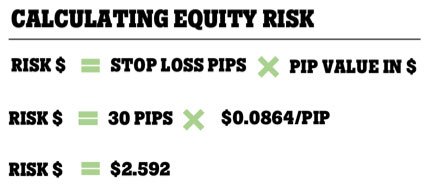
And as a % of your account.
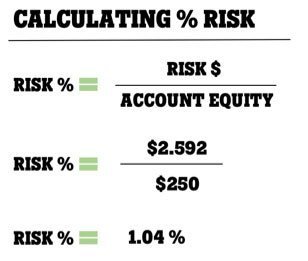
Leverage is a powerful tool, but the level of risk increases on your account as you increase the amount of leverage used on your trade. The leverage used will be included in your calculation as follows. This example using the leverage of 1:10 as an example.
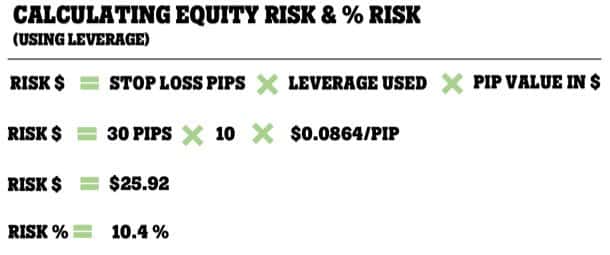
By doing these calculations, you can see where your limitations will be and if the risk will be too high for your account. Regardless of your belief in a trade, you will always have trades that go against you, so risk management at a trade level is vital. That said, make sure you set a win-loss ratio that suits you.
A trader must have more wins than losses to succeed in trading over the long term. Successful traders generally risk less on a trade than they can make on a trade. There is no exact ratio you can follow because it changes depending on the length of the trade and the pair traded. The goal is to minimise risk as much as possible and to try to maximise the profits.
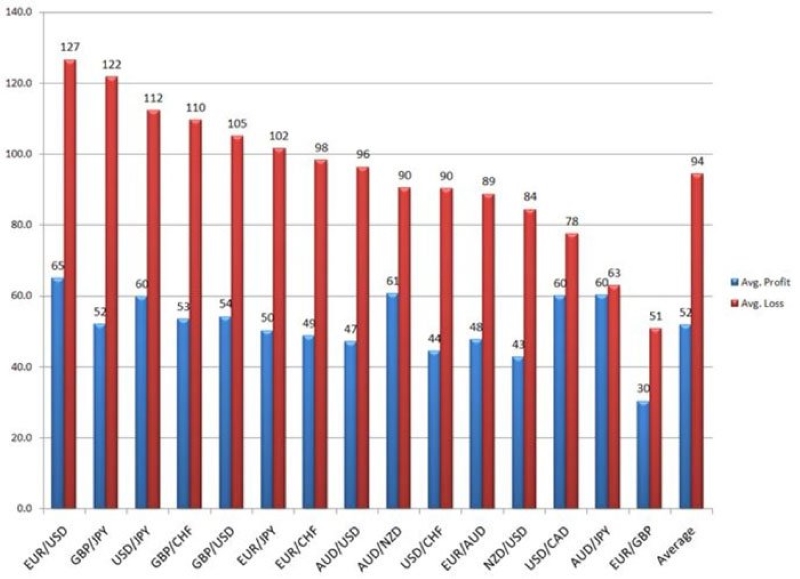
One of the largest US retail Forex brokers, after studying millions of trades made by their clients, found that even though their retail traders were more often right than wrong they were still losing money. They concluded that the sole reason why traders lose money over the long haul is that “they lose more money on their losing trades than they make on their winning trades.”
The risk of ruin refers to the probability of losing all your trading capital. Let’s assume you risk 5% on every trade. Also, let's bring the risk of ruin and the risk-to-reward ratio into the example (see Figure 1 below).
The higher the risk-to-reward ratio is, the less % of trades need to be won.
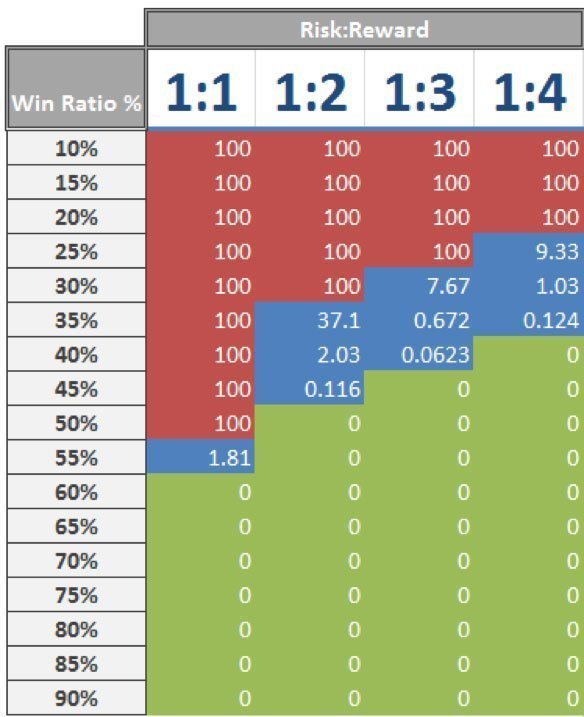
Figure 1: Risk of Ruin Table Example - Risking 5% of equity per trade
If Forex trading is to be a money-making business, you must control for risk. You need to reduce risk through sourcing information, keeping track of critical ratios of risk-loss, and understanding where your limitations are. The most successful Forex traders are the ones who know themselves the best. They have created a trading plan that outlines how trading will fit into their lives and how they will trade opportunities. They repeat the same steps within this framework whenever they approach their work.
Curious about the latest in forex? You’re not alone. Many traders and investors are digging deeper into these topics to refine their strategies and understanding. Here’s a curated selection of “others also viewed” articles, offering a range of perspectives and insights that could prove valuable for your own forex journey.

Good Forex brokers for beginners will help their clients get started. These are the best Forex brokers for beginners in Australia for 2026.

Which broker offers the lowest spreads? We compare Forex spreads across 160+ regulated Forex brokers accepting Australian clients using the latest data.

Find the best brokers for trading the VIX, offering precise execution, low fees, and advanced tools to capitalise on market volatility.
Partner Manager and Financial Writer
Head of Content
Financial Writer